Royal Health Care InstituteThe Health Care Training School dedicated to giving you an edge for career successCONTACT USStart Training For Your Career With RoyalInspire patients. Become a health care heroGET STARTEDNurse Aide TrainingTake the first step to a rewarding career in the healthcare industryAPPLY ONLINE NOW
Start Your Healthcare Career Right Here in Massachusetts
The demand for qualified home health aides and nurse aides has never been stronger. According to the U.S. Bureau of Labor Statistics, employment for home health and personal care aides is projected to grow much faster than average — and Massachusetts is no exception. Whether you’re asking how to become a home health aide, how to become a nurse aide, or simply where to find a nurse aide program near you, Royal Health Care Institute (RHCI) is your answer.
We are a Massachusetts-licensed, state-approved Nursing Assistant and Home Health Aide training school, operating in full compliance with the Massachusetts Department of Public Health Nurse Aide Registry for our Nursing Assistants Program and the Division of Occupational Licensure, Office of Private Occupational Schools. Our programs are designed to get you ready to take the state’s certification exam, job-ready, and confident — as quickly and thoroughly as possible.
Additionally, RHCI is an approved Massachusetts Nurse Aide Competency Examination testing site. Eligible candidates may complete training and take the state examination at an approved RHCI location, subject to testing availability and TMU scheduling.
Royal HCI Programs - 3 Paths to a Healthcare Career
At Royal Health Care Institute, we offer three focused, practical programs designed to get you trained and working in healthcare as efficiently as possible. Whether you want the full dual-credential experience, a streamlined education that prepares students to work in the field of home health care, or a critical life-saving skill that every healthcare worker needs — we’ve got you covered.
Royal Health Care Institute is licensed by the Massachusetts Division of Occupational Licensure (DOL), Office of Private Occupational School Education (POSE).
Nurse Aide Training & Home Health Aide
Get two credentials. One Program. Maximum Career Opportunity.
Our flagship Dual Nursing Assistant and Home Health Aide Training Program (NATP) is our most comprehensive offering — and the one that opens the most doors.
Students who successfully complete the program receive Nurse Aide Training and Home Health Aide become eligible to take the Massachusetts Nurse Aide Competency Examination.
The program is deeply hands-on, with clinical hours built right in — so you leave with real experience. Along the way, you’ll cover everything from personal care and vital signs to Alzheimer’s support and end-of-life care.
If you want to enter the healthcare workforce with the strongest possible foundation — or keep your options wide open for future nursing studies — this is the program to start with.
Home Health Aide
Caring for Clients in the Comfort of Their Own Homes.
The Home Health Aide (HHA) Training Program is a standalone program for students looking to build a career in home-based care. As the population ages and more people choose to receive care at home, the demand for skilled, compassionate aides has never been stronger.
Students gain the hands-on skills needed to provide safe, personal care in a client’s home — including hygiene assistance, meal prep, vital sign monitoring, medication reminders, and infection control — all while learning to follow a nurse-developed care plan and communicate effectively with the broader care team.
Graduates who complete the program and pass their competency evaluation are ready to work with home health agencies, assisted living programs, hospice organizations, and personal care firms across Massachusetts and beyond. If you thrive in a one-on-one setting and want to make a real difference in someone’s daily life, this program is for you.
CPR & First Aid
Life-Saving Skills Every Healthcare Professional Needs.
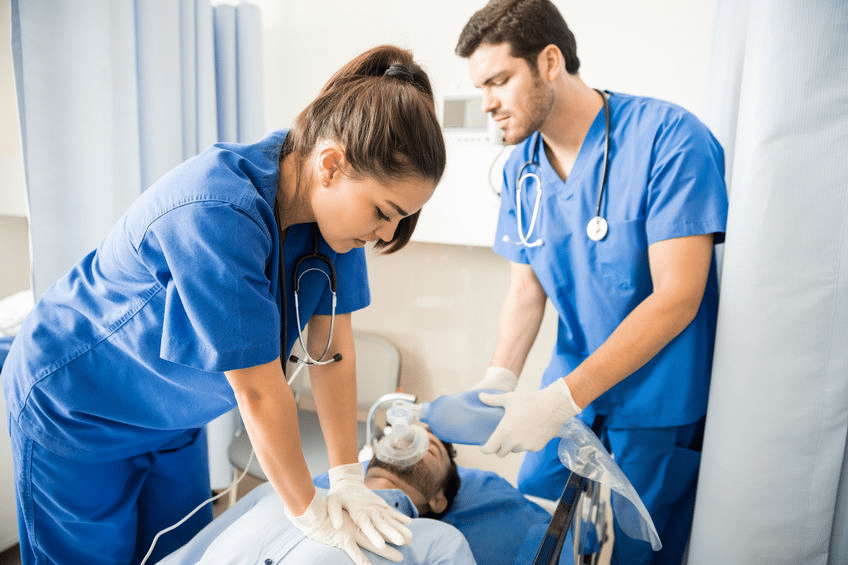
The CPR/BLS/First Aid Certification is a short, hands-on program for both new students and working healthcare professionals. Many healthcare and caregiving employers require or strongly prefer current CPR/BLS certification. Requirements vary by profession, employer, and work setting.
Following American Heart Association (AHA) guidelines, the class covers CPR for adults, children, and infants; AED use; airway obstruction relief; and basic first aid for bleeding, burns, choking, and shock. Students practice on manikins and walk away with their certification card. BLS certification is valid for two years.
This seminar is available as a standalone certification for caregivers, community members, and professionals, and pairs well with our Nurses Aide (NA) and HHA programs. Whether you’re just starting out or due for renewal, getting trained at RHCI is straightforward and fast.
“Our program prepares you for employment as a Nurses Assistant (NA) and equips you with essential skills for future healthcare studies, including Nursing and other allied health pathways.”
— Paul A. Fuanyi, MHA, LNHA, CDP School President, Royal Health Care Institute
What Does a Home Health Aide or Nurse Aide Actually Do?
Before you enroll in a nurse aide or home health aide program, it helps to understand exactly what these roles involve — because they’re more meaningful than most people realize.
A Nurses Assistant (NA) works under the direct supervision of a licensed nurse in settings like long-term care facilities, skilled nursing homes, hospitals, and assisted living residences. Day to day, an NA assists patients with:
Personal hygiene — bathing, grooming, dressing
Vital signs — taking and recording temperature, pulse, respiration, and blood pressure
Mobility assistance — repositioning, transfers, and ambulation support
Nutrition support — assisting with meals and hydration
Infection control — following proper protocols to keep patients and staff safe
Emotional support — building compassionate, person-centered relationships with residents
A Home Health Aide (HHA), on the other hand, typically works in a client’s private home, providing similar personal care services — but also taking on light housekeeping, meal preparation, grocery shopping, and help with scheduling medical appointments. HHAs work under the supervision of a Registered Nurse who develops a written care plan, and they follow that plan closely to ensure the client’s safety and comfort.
Both roles are deeply rewarding. They are also, frankly, among the most in-demand jobs in the entire healthcare sector.
How to Become a Home Health Aide in Massachusetts
Here's the straightforward path to becoming a Home Health Aide (HHA) in Massachusetts:
Step
What You Do
1. Enroll in an approved training program
Attend an approved school like RHCI. Federal guidelines require a minimum of 75 hours of training, including at least 16 hours of supervised clinical experience. Massachusetts follows the federal standard (42 CFR 484.36).
2. Complete classroom & clinical hours
Learn personal care, infection control, vital signs, nutrition, safety, and more — in both classroom and hands-on settings.
3. Pass a competency evaluation
Demonstrate your skills through a written exam and practical skills assessment.
4. Obtain CPR certification
Most employers and agencies require current CPR/BLS certification. RHCI offers this as a standalone course.
5. Begin working
Once done, you can work through home healthcare agencies.
Why Choose RHCI for Your Nurse Aide or Home Health Aide Training?
There are plenty of nurse aide and home health aide programs out there — so why RHCI? Here’s what sets us apart:
✅ State-licensure and Industry Compliance — Royal Health Care Institute is licensed by the Massachusetts Division of Occupational Licensure (DOL), Office of Private Occupational School Education (POSE). Our NATP program complies with DPH requirements
✅ Dual Credential option — Earn both your NA and HHA credentials simultaneously through our flagship program
✅ Competency-based, hands-on curriculum — Real skills, real clinical experience, real readiness
✅ Supportive, student-centered environment — Small class sizes, experienced faculty, and a team that genuinely cares about your success
✅ Comprehensive examination preparation and individualized student support — Our program is designed to get you through your competency evaluation with confidence
✅ Career pathway focus — RHCI isn’t just a school; it’s the beginning of your healthcare journey, with pathways toward nursing and allied health careers
Whether you’re just starting out, switching careers, or looking to formalize skills you already have, RHCI has a nurse aide or home health aide program that fits your life. Classes are forming now — don’t wait to take the first step.